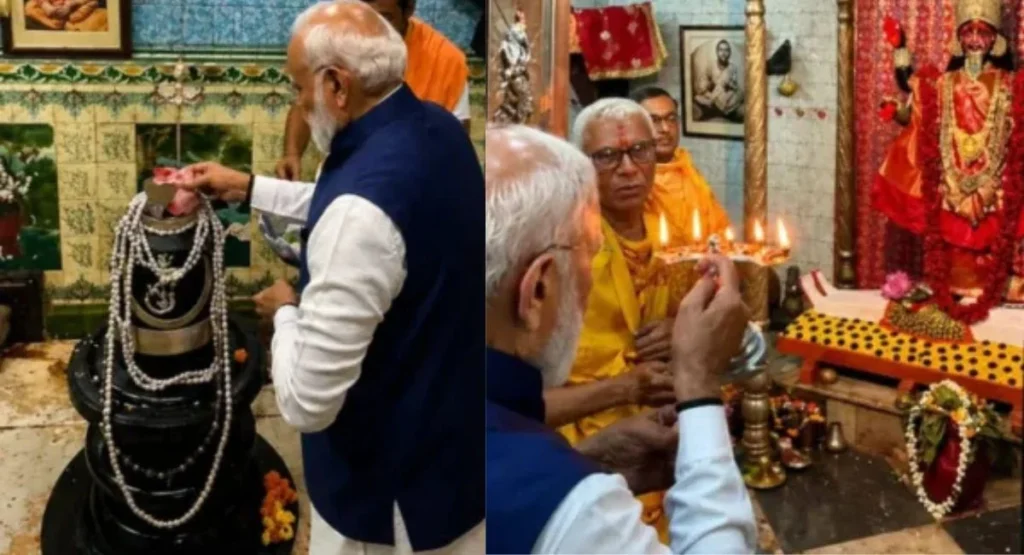
In a significant political gesture, Prime Minister Narendra Modi visited a temple in West Bengal where non-vegetarian Prasad is offered, marking a noteworthy moment in the ongoing political landscape of the state. This visit not only highlights the cultural diversity and the unique practices of worship within the region but also serves as a strategic response to the Trinamool Congress (TMC), the ruling party in West Bengal. By participating in this tradition, Modi is signaling his acknowledgment of the local customs and beliefs, which is a crucial aspect of engaging with the electorate in a culturally rich state like Bengal.
The offering of non-vegetarian Prasad is a practice that reflects the local traditions and has deep roots in the community’s religious practices. By bowing his head in reverence at this temple, Modi aims to connect with the sentiments of the people who uphold these traditions. This act can be interpreted as an attempt to bridge the gap between his party and the local populace, showcasing an understanding and respect for their cultural values. The significance of this gesture goes beyond mere politics; it is a demonstration of Modi’s commitment to embracing the diverse tapestry of India’s religious and cultural practices.
Moreover, this visit can be seen as a calculated move in the larger political narrative as the Bharatiya Janata Party (BJP) seeks to strengthen its foothold in West Bengal, a state where the TMC has maintained a stronghold for years. By engaging in local customs, Modi is not only appealing to the sentiments of the people but also positioning the BJP as a party that respects and honors the state’s unique identity. This could potentially sway undecided voters and reinforce the BJP’s image as a party that values inclusivity and cultural heritage.
In essence, Modi’s bow at the temple serves multiple purposes: it is a show of respect for local traditions, a political strategy aimed at countering the TMC’s dominance, and a message of unity that seeks to bring together diverse communities under a common political umbrella. As the political landscape continues to evolve, such gestures may play a crucial role in shaping the future dynamics of West Bengal’s electoral politics.