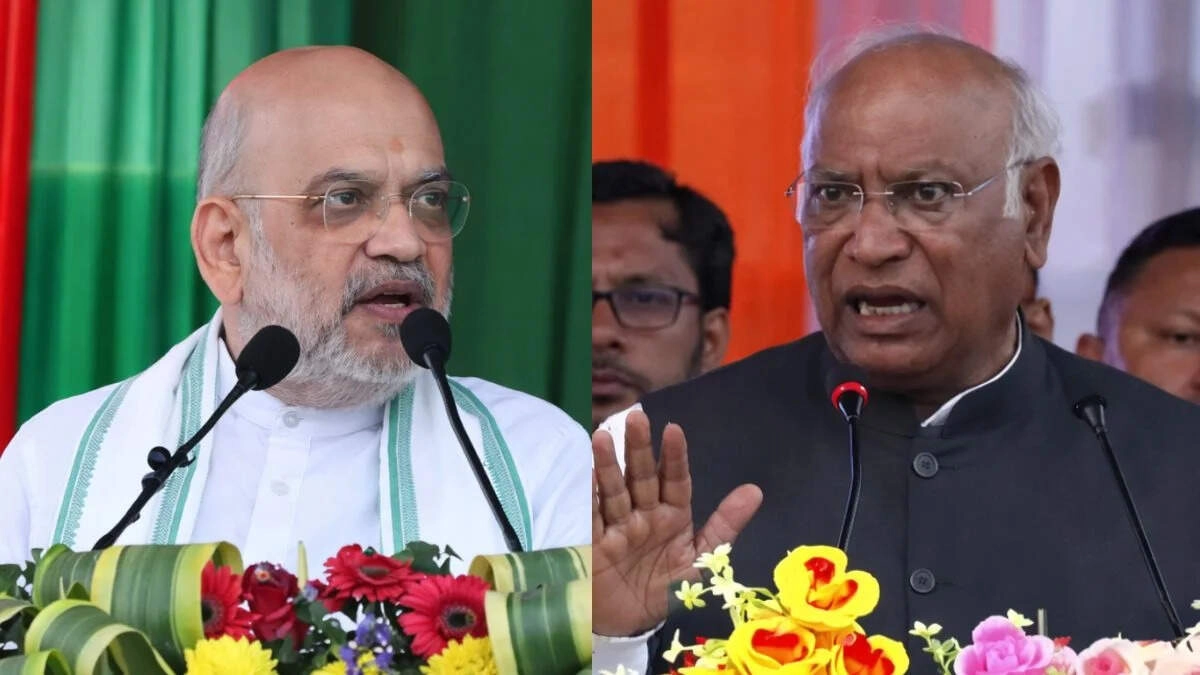
A controversy has erupted following a statement made by Mallikarjun Kharge, the president of the Indian National Congress, in which he compared the Bharatiya Janata Party (BJP) and its ideological parent, the Rashtriya Swayamsevak Sangh (RSS), to a poisonous snake. This comparison has sparked significant political tension, leading to widespread discussions and reactions across the political spectrum. The remarks came at a time when political sentiments are already running high, and the subsequent filing of a First Information Report (FIR) against Kharge has further intensified the situation.
Kharge’s comments were likely intended to criticize what he perceives as the harmful and toxic nature of the BJP and RSS in the current political landscape. However, the metaphor of a “poisonous snake” has drawn sharp rebukes from various leaders and supporters of the BJP and RSS, who argue that such language is inflammatory and divisive. This incident underscores the ongoing political polarization in India, where rhetoric often escalates quickly, reflecting the deep ideological divides between the ruling party and the opposition.
As the political temperature rises, both parties are gearing up for potential confrontations. The BJP has called for Kharge to apologize for his remarks, framing them as an attack on the very foundations of Indian politics and society. On the other hand, Kharge and his supporters maintain that his comments were a necessary critique of the BJP’s governance and policies, which they argue have detrimental effects on the country. This incident serves as a reminder of how political discourse in India can quickly spiral into heated exchanges, with both sides leveraging the situation to galvanize their respective bases ahead of upcoming elections.