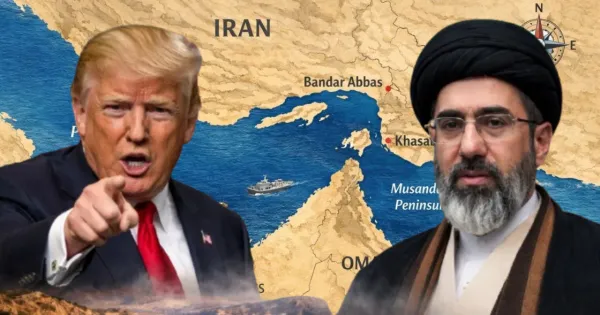
Former President Donald Trump has issued a stern warning to Iran, demanding that the country cease its aggressive actions against tankers navigating through the strategically vital Strait of Hormuz. This crucial waterway serves as a major passage for oil shipments and international trade, making it a focal point of geopolitical tension. Trump’s statement reflects ongoing concerns about Iran’s influence in the region and its potential to disrupt global oil supplies.
The Strait of Hormuz is a narrow stretch of water that connects the Persian Gulf to the Arabian Sea, and it is one of the most important maritime corridors in the world. A significant percentage of the world’s oil trade flows through this strait, highlighting its importance not only to regional powers but also to global economies. Trump’s warning underscores the United States’ commitment to ensuring the safety and security of maritime navigation in this area, particularly in light of Iran’s recent actions that have raised alarm among international communities.
In recent months, there have been heightened tensions between the U.S. and Iran, with both sides engaging in a war of words and military posturing. The U.S. has sought to counter what it perceives as Iranian aggression, which includes harassment of commercial vessels and threats to shipping lanes. Trump’s warning serves as a reminder that any disruption to the flow of oil could have far-reaching consequences, potentially leading to increased prices and instability in energy markets worldwide.
The situation remains precarious, as Iran’s response to such warnings could further escalate tensions in an already volatile region. The U.S. has emphasized its readiness to defend its interests and those of its allies, indicating that it will not tolerate any interference with maritime trade. As the international community closely monitors these developments, the potential for conflict looms, raising questions about the future dynamics of U.S.-Iran relations and the stability of global oil markets.