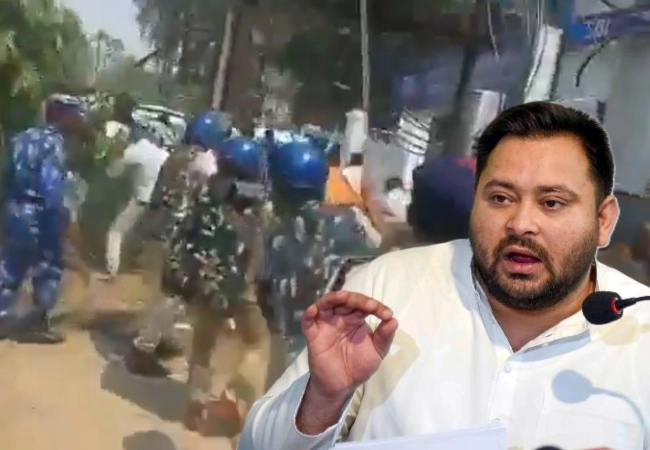
In a recent political confrontation, Tejashwi Yadav took a strong stance against Samrat Sarkar regarding the police lathi charge on youth protestors in Patna. During a heated exchange, Tejashwi criticized the government for its heavy-handed approach to handling the youth, suggesting that the administration’s response was not just excessive but also indicative of a deeper systemic issue. He argued that rather than addressing the grievances of the younger generation, the government is resorting to brute force, which only serves to alienate and frustrate the youth further.
Tejashwi’s remarks highlighted a broader concern about the government’s priorities. He provocatively suggested that instead of empowering the youth by providing them with opportunities and platforms to voice their concerns, the administration seems more inclined to suppress dissent through violence. This approach, he asserted, not only undermines the democratic values of the nation but also fails to acknowledge the aspirations and rights of young citizens who are the future of the country. By urging the government to “make your children ministers,” Tejashwi implied that the current leadership is out of touch with the realities faced by the youth.
The lathi charge incident in Patna has sparked widespread condemnation, with many viewing it as a symbol of the government’s unwillingness to engage in constructive dialogue. Tejashwi’s critique serves as a rallying cry for those who believe that the voices of the youth should be heard and respected. He pointed out that the youth are not merely subjects to be controlled but active participants in shaping the future of the nation. The call for reform and a more inclusive approach to governance resonates with many, as it emphasizes the importance of listening to the concerns of all citizens, especially those who are most affected by policy decisions.
As the political discourse continues to evolve, the confrontation between Tejashwi and Sarkar reflects a growing divide in how different factions within the government view the role of youth in society. The implications of this clash extend beyond Patna, as it raises critical questions about governance, representation, and the means by which the government engages with its citizens. In a time when youth activism is on the rise, the need for dialogue and understanding has never been more crucial. Tejashwi’s challenge to the government to reconsider its approach may very well resonate with a generation eager for change and empowerment.