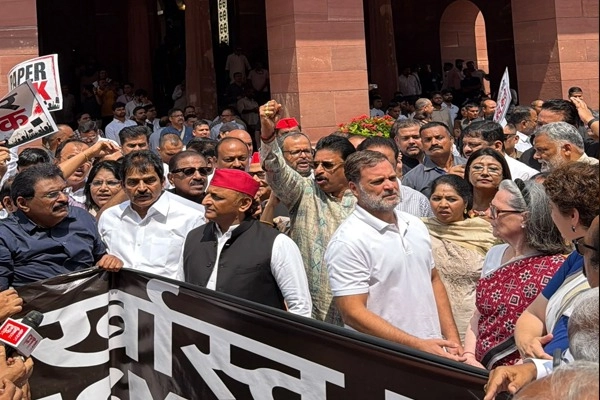
In a significant political move, prominent leaders including Rahul Gandhi, Akhilesh Yadav, and Mahua Moitra have staged a protest in Parliament, demanding the resignation of Union Minister Dharmendra Pradhan. This demonstration underscores the growing tensions within the Indian political landscape, as these leaders rally together to voice their concerns regarding various issues plaguing the nation. The protest reflects a unified opposition front, highlighting their dissatisfaction with the current government’s policies and actions, particularly in the education and energy sectors, areas overseen by Pradhan.
The call for Pradhan’s resignation stems from allegations of mismanagement and failure to address critical issues affecting the public. The protesters argue that under Pradhan’s leadership, there has been a decline in educational standards and a lack of effective energy policies that cater to the needs of the citizens. Rahul Gandhi, a seasoned leader of the Congress party, has been vocal about the need for accountability and transparency in governance, asserting that the government must be held responsible for its shortcomings.
Akhilesh Yadav, representing the Samajwadi Party, echoed these sentiments, emphasizing the necessity for a government that prioritizes the welfare of its people. Meanwhile, Mahua Moitra, known for her articulate and incisive critiques of the ruling party, brought attention to the broader implications of the current policies on education and energy, arguing that they are detrimental not only to the present generation but also to the future of the country. The protest serves as a reminder of the fractious nature of Indian politics, where issues of governance and accountability are continuously contested in the public sphere.
As the protest unfolds, it is evident that the opposition is leveraging this moment to galvanize support from the public and other political factions. Their collective action aims to create a narrative of resistance against what they perceive as an ineffective administration, hoping to inspire citizens to demand better governance. The outcome of this protest could have significant implications for the political landscape in India, as it highlights the challenges faced by the ruling government in maintaining its legitimacy amidst growing dissent. The leaders’ united front in Parliament could potentially shift the dynamics of political discourse in the country, prompting further discussions on accountability and reform.