
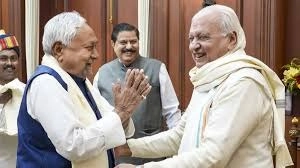
The political landscape of Bihar is witnessing a significant shift as the era of Chief Minister Nitish Kumar comes to a close. After years of leading the state, Kumar is set to transition to the Rajya Sabha, marking the end of his tenure as the chief executive of Bihar. This move has been interpreted as a strategic masterstroke by the Bharatiya Janata Party (BJP), which has been keenly observing the unfolding political dynamics in the region. The BJP’s maneuvering indicates a calculated effort to consolidate power and influence in Bihar, a state that has seen its fair share of political upheaval.
As Nitish Kumar steps down from his role, the question of who will assume the position of Chief Minister looms large. Several names are being discussed as potential successors, and political analysts are closely monitoring the developments. The BJP, having played a pivotal role in the formation of the government alongside Kumar’s party, is likely to propose a candidate who aligns with its vision and policies. This transition could signify a new chapter in Bihar’s governance, as the BJP aims to strengthen its foothold in the state amid changing political tides.
This development also raises questions about the future direction of Bihar’s policies and governance. Nitish Kumar has been a prominent figure in Bihar politics, known for his focus on development and social welfare. The incoming Chief Minister will have the task of building on Kumar’s legacy while also addressing the concerns of the electorate. As the BJP consolidates its power, it will be essential for the new leadership to maintain stability and foster growth in a state that has faced various challenges over the years. The coming weeks will be crucial as the political scenario unfolds, setting the stage for the next phase of governance in Bihar.


