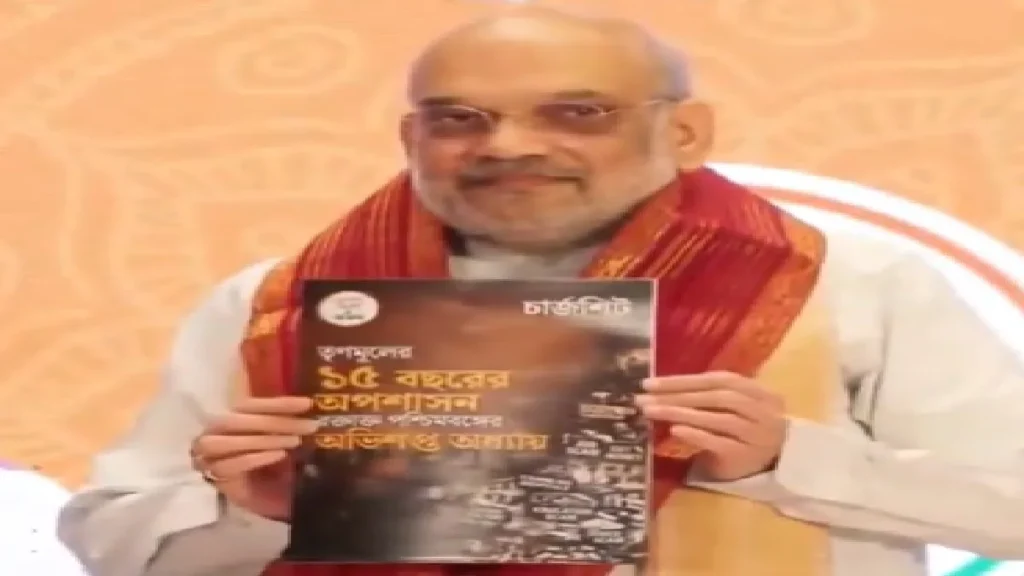
Amit Shah, the Union Home Minister and a prominent leader of the Bharatiya Janata Party (BJP), has recently intensified his criticism of West Bengal Chief Minister Mamata Banerjee and her party, the Trinamool Congress (TMC). In a strategic move, he unveiled a detailed chargesheet that outlines 14 specific allegations against the TMC government. This action appears to be a calculated effort to undermine Banerjee’s political standing ahead of upcoming elections, as Shah seeks to bolster the BJP’s influence in a state where it has been working to establish a stronger foothold.
The chargesheet highlights various issues that the BJP claims reflect the TMC’s governance failures and corruption. Shah’s allegations range from administrative inefficiencies to accusations of political violence and nepotism, aiming to paint a picture of a government that has lost its way. By publicly presenting these charges, Shah not only seeks to rally the BJP’s base but also aims to sway undecided voters by portraying the TMC as unfit to govern. This move is part of a broader strategy to capitalize on the discontent among the populace regarding local governance and to position the BJP as a viable alternative.
Mamata Banerjee and the TMC have consistently dismissed these allegations as politically motivated, suggesting that Shah’s actions are indicative of desperation as the BJP struggles to gain traction in West Bengal. The TMC has accused the BJP of attempting to divert attention from its own shortcomings at the national level. The political rhetoric between the two parties has escalated, with both sides exchanging barbs and accusations. This ongoing conflict reflects the high stakes involved in West Bengal’s political landscape, where both parties are vying for legitimacy and support from the electorate.
As the political climate heats up, the impact of Shah’s chargesheet remains to be seen. It is clear that the BJP is committed to challenging the TMC’s dominance in West Bengal, and the coming months will likely see increased political activity as both parties prepare for the electoral battle ahead. The outcome of this confrontation could have significant implications for the future of governance in the state, shaping the lives of millions of residents who are eager for change and effective leadership.