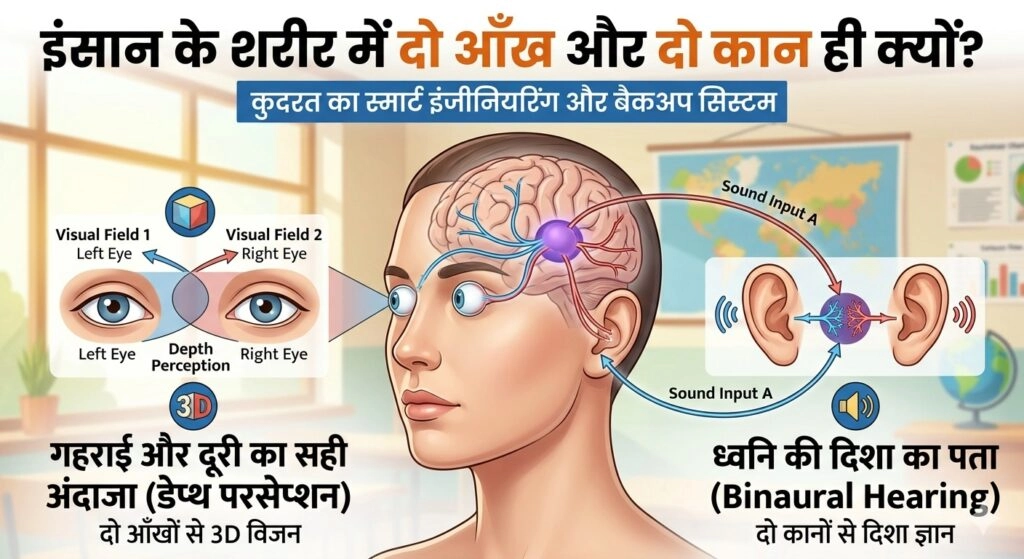
The human body exhibits a remarkable symmetry, particularly evident in the presence of two eyes and two ears. This design is not merely a coincidence but rather a product of evolutionary adaptation that serves several crucial functions for survival and interaction with the environment. Having two eyes allows for binocular vision, which enhances depth perception and enables a more accurate assessment of distances. This capability is essential for activities such as hunting, navigating through complex environments, and avoiding potential dangers. The positioning of the eyes on the front of the face further aids in providing a wide field of view, while still allowing for focused vision on specific objects.
Similarly, the duality of ears plays a vital role in auditory perception. Two ears enable a phenomenon known as sound localization, which helps individuals determine the direction from which a sound originates. This ability is crucial for survival, as it allows humans and other animals to detect predators or prey more effectively. The brain processes the slight differences in sound arrival time and intensity between the two ears to create a spatial map of the surrounding environment. Without this stereophonic hearing, our ability to interact with and respond to the world around us would be significantly compromised.
Moreover, the evolutionary rationale for having two eyes and two ears ties back to the overall balance and symmetry observed in nature. Many organisms exhibit bilateral symmetry—having two sides that mirror each other—which is thought to provide advantages in mobility and coordination. This symmetry is not just aesthetically pleasing but may also enhance efficiency in movement and sensory processing, contributing to the organism’s survival and reproductive success.
While some animals possess different sensory adaptations, the human configuration of two eyes and two ears has proven advantageous over time, facilitating complex interactions with our environment. The science behind this design reflects a long evolutionary journey where survival, efficiency, and functionality have shaped the anatomical features we possess today. Understanding these aspects of our biology not only sheds light on our evolutionary past but also emphasizes how our sensory systems work together to create a cohesive experience of the world around us.