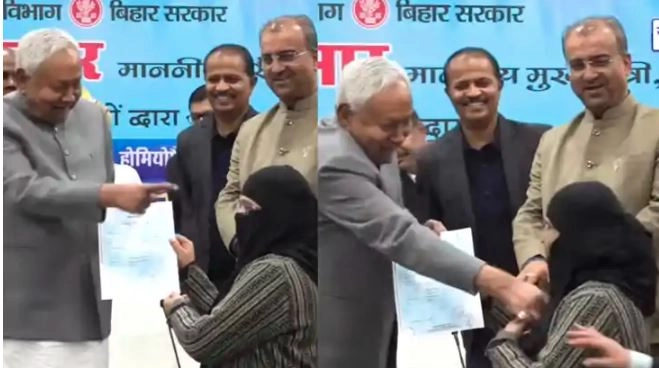
In a surprising and controversial incident, Nitish Kumar, the Chief Minister of Bihar, was seen removing the hijab of a Muslim woman, a moment that has sparked widespread shock and outrage among the public. This unexpected action has raised numerous questions regarding the Chief Minister’s intentions and the implications of such a gesture in a diverse society like India, where religious sentiments and cultural practices are deeply valued. The video of this incident was shared by the Rashtriya Janata Dal (RJD), a prominent opposition party in the state, which further fueled the debate about the Chief Minister’s conduct and the state government’s stance on religious freedom.
The incident has not only caught the attention of political leaders but has also ignited discussions among various social and community groups. Many people are left wondering what could have prompted such an action from a leader who is expected to uphold democratic values and respect for all communities. Critics argue that this display undermines the right of individuals to express their religious beliefs and could be seen as an attempt to marginalize a particular community. In a country where secularism is a foundational principle, such acts can lead to significant backlash and polarization among different religious and ethnic groups.
The RJD’s decision to publicly share the video indicates their strategy to capitalize on this incident to question Kumar’s leadership and to galvanize support from those who feel threatened by the erosion of religious liberties. The political ramifications of this event could be far-reaching, as it may lead to increased tensions between communities and further complicate the already intricate dynamics of Bihar’s political landscape. As reactions continue to pour in from all corners, it remains to be seen how the Chief Minister and his office will respond to the mounting criticism and whether this incident will have lasting effects on his political career and the broader societal fabric of the region.