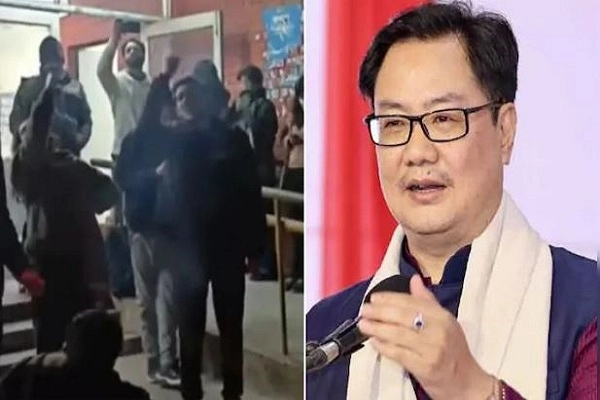
A First Information Report (FIR) has been registered at Jawaharlal Nehru University (JNU) following the emergence of slogans that were directed against prominent political figures, namely Prime Minister Narendra Modi and Home Minister Amit Shah. The slogans, which have sparked significant controversy, have raised concerns about freedom of speech and the implications of dissent in India. This incident has ignited a heated debate within the university and beyond, reflecting the polarized political climate in the country.
In response to the FIR and the slogans, Union Law Minister Kiren Rijiju made a statement emphasizing that India must distance itself from what he termed “sick people” who engage in such expressions of dissent. Rijiju’s comments reveal a broader narrative within the ruling party, suggesting that there is little tolerance for criticism directed at the government. His remarks have been interpreted by some as an attempt to delegitimize opposition voices and suppress dissent, raising questions about the state of democracy and free expression in India.
The situation at JNU is emblematic of the ongoing tensions between the government and various student groups who have taken to the streets to voice their concerns over a range of issues, including nationalism, social justice, and government policies. The university has historically been a hotbed for political activism and dissent, making it a focal point for discussions about civil liberties and the right to protest. As this incident unfolds, it underscores the critical balance that must be struck between maintaining public order and protecting the fundamental rights of citizens to express their views, even when they are in opposition to those in power.
The incident raises pivotal questions about the nature of political discourse in India. As the country navigates its complex socio-political landscape, the responses from both the government and civil society will be crucial in shaping the future of democratic engagement. The evolving situation at JNU is a reflection of broader societal tensions and the ongoing struggle for voices that challenge the status quo to be heard within the political arena.