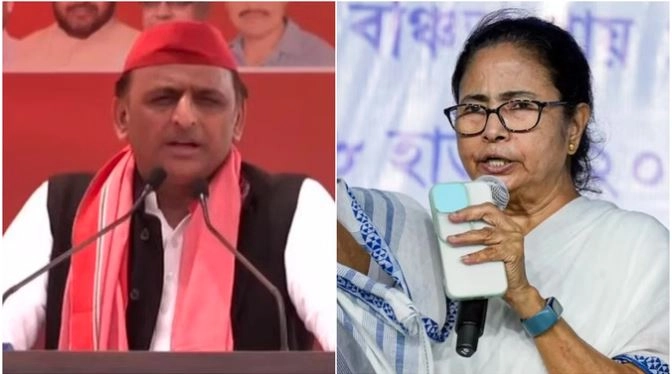
Akhilesh Yadav, the leader of the Samajwadi Party, recently made a statement asserting that only Mamata Banerjee, the Chief Minister of West Bengal, has the capability to effectively challenge the Bharatiya Janata Party (BJP) in the current political landscape. His remarks highlight the growing recognition of Banerjee’s political influence and her potential as a formidable opponent against the ruling party at the national level. Yadav’s endorsement of Banerjee as a key player in the resistance against the BJP indicates a strategic alliance among regional parties, which could reshape the dynamics of Indian politics as the nation approaches crucial elections.
In his comments, Yadav also referenced the BJP’s past electoral struggles, notably mentioning the “pain of losing the pen drive.” This phrase has become somewhat symbolic of their electoral failures, particularly during the time when the BJP faced unexpected defeats in various states. This allusion serves to remind both the party and the electorate of their vulnerabilities. By invoking this memory, Yadav aims to emphasize that the BJP is not invincible and that it has experienced setbacks, which could be leveraged by a united opposition.
The significance of Yadav’s statement lies not only in its immediate political implications but also in the broader context of coalition-building among opposition parties. As various regional parties seek to consolidate their strengths against the BJP, Yadav’s acknowledgment of Banerjee’s role signifies a potential shift towards greater collaboration. This could lead to a more cohesive front capable of challenging the BJP’s dominance, especially in states where regional parties hold sway. As the political landscape evolves, the interactions between these leaders will be crucial in determining the future of opposition politics in India.