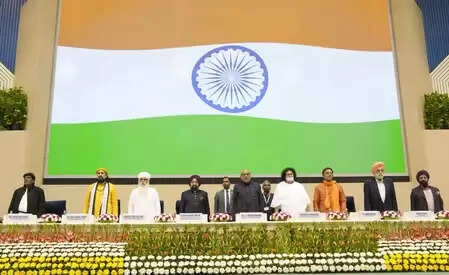
In a recent meeting aimed at resolving the ongoing deadlock between the Bharatiya Janata Party (BJP) and the Janata Dal (United) or JDU, Union Home Minister Amit Shah emphasized the importance of unity in achieving political objectives. The discussions, which were closely watched by political analysts and party workers alike, sought to address the rift that had developed between the two parties over various issues, including seat sharing for upcoming elections and differences in policy approaches. Shah’s assertion that “Unity will yield results” highlights the critical nature of collaboration in the political landscape, especially in a coalition government where divergent interests can easily lead to discord.
The meeting provided a platform for both parties to air their grievances and seek common ground. Amit Shah’s leadership was pivotal in steering the dialogue towards a more constructive path. His message resonated with party officials, suggesting that despite the challenges, a united front could enhance their electoral prospects. In the context of the upcoming elections, the stakes are particularly high, making it imperative for the BJP and JDU to present a cohesive strategy to their constituents. Shah’s remarks reflect a broader understanding of the need for alliances in Indian politics, where coalition governments are often the norm.
As the discussions unfolded, both parties recognized that their combined strengths could be leveraged to counter opposition forces effectively. The necessity for a collaborative approach becomes even more pronounced in a politically vibrant state like Bihar, where both the BJP and JDU have historically played significant roles. The ongoing political maneuvering illustrates the dynamic nature of alliances in Indian politics, where unity is not merely a strategic choice but a necessity for survival and success. Amit Shah’s call for unity serves as a reminder that, in the ever-evolving political arena, cooperation often leads to more favorable outcomes than isolation.
In conclusion, Amit Shah’s emphasis on unity during the meeting with JDU leaders underscores a pivotal moment in the relationship between these two parties. By fostering dialogue and understanding, both sides can work towards resolving their differences and formulating a united front. This approach not only enhances their chances in the upcoming elections but also strengthens the foundations of their coalition. The political landscape in Bihar is watching closely, as the ramifications of this meeting could significantly influence the future of both parties and the state’s governance. Unity, as Shah suggests, may indeed yield results that resonate beyond immediate electoral gains, shaping the political narrative in Bihar for years to come.