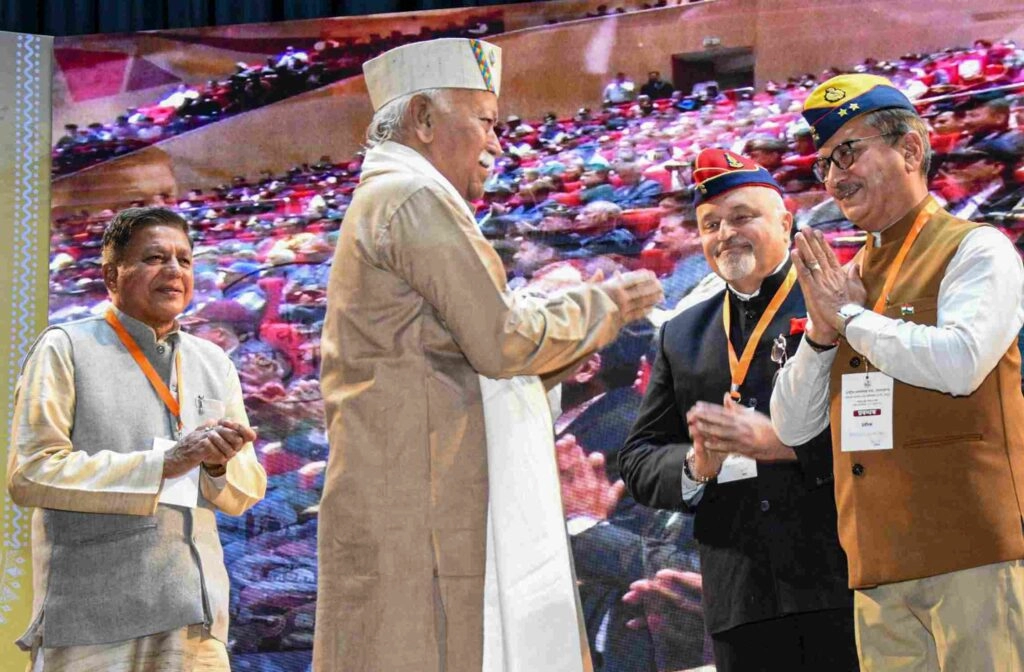
Mohan Bhagwat, the chief of the Rashtriya Swayamsevak Sangh (RSS), has expressed strong support for the implementation of a nationwide Uniform Civil Code (UCC), emphasizing its significance in fostering societal unity. He articulated that a UCC is essential for harmonizing the diverse cultural and religious practices in India, promoting equality and justice for all citizens irrespective of their personal laws. Bhagwat’s advocacy for the UCC aligns with the broader vision of creating a cohesive society where every individual is treated equally under the same legal framework.
During a recent address, Bhagwat highlighted that the UCC is not merely a legal reform but a necessary step towards national integration. He argued that different personal laws based on religion or community can lead to fragmentation within society, which is counterproductive to the idea of a unified nation. By establishing a uniform set of civil laws governing marriage, divorce, inheritance, and adoption, the UCC aims to eliminate disparities and promote fairness, particularly for marginalized groups who often suffer under varied personal laws.
Bhagwat’s call for a UCC resonates with many who believe that such a code would strengthen the secular fabric of India. He noted that a uniform legal framework would not only ensure equal rights for all citizens but also reinforce the principles of justice and equality enshrined in the Constitution. By advocating for the UCC, Bhagwat is encouraging a dialogue on the need for reforms that reflect contemporary values and the aspirations of a diverse population, thereby paving the way for a more inclusive society.
In conclusion, the push for a nationwide Uniform Civil Code by Mohan Bhagwat signifies a crucial step toward addressing the complexities of personal laws in India. It reflects a vision for a society where the principles of equality and justice prevail, and where every citizen, regardless of their background, can experience the same legal protections and rights. As discussions surrounding the UCC continue, it remains to be seen how these ideas will be received and implemented in a country known for its rich tapestry of cultures and traditions.