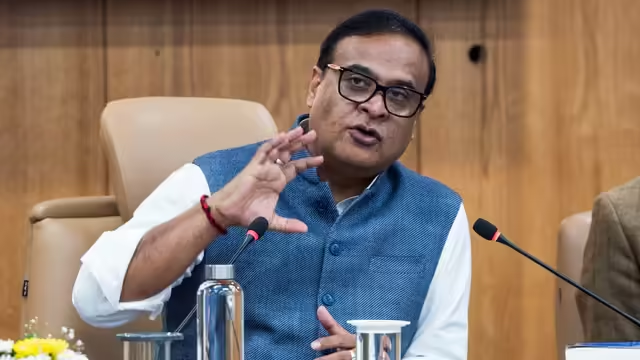
Assam’s Chief Minister made a pointed remark regarding the Babri Masjid being constructed in Murshidabad, questioning the validity of the project by stating, “When the original no longer exists, then what is the point of this?” His statement appears to reflect a broader sentiment regarding the historical and cultural significance of the site in question. The Babri Masjid, which was originally located in Ayodhya, has been at the center of a contentious dispute for decades, symbolizing a much larger conflict between different religious communities in India.
The Chief Minister’s comments highlight the ongoing tensions surrounding religious sites in the country. The Babri Masjid was demolished in 1992, leading to widespread riots and a protracted legal battle that culminated in a Supreme Court ruling in 2019 favoring the construction of a Ram Temple at the disputed site. This ruling not only reignited discussions about the mosque but also raised concerns about the implications for secularism and communal harmony in India.
In the context of Murshidabad, a region known for its rich historical and cultural heritage, the Chief Minister’s remarks may resonate with those who feel that the reconstruction of religious sites should be approached with sensitivity and awareness of historical contexts. The comments also serve as a reminder of the complexities involved in religious and cultural identity in India, where historical narratives are often contested and reinterpreted. It raises questions about how communities can navigate these differences while promoting coexistence and mutual respect.
Overall, the Chief Minister’s statement underscores the ongoing dialogue about religious identity and heritage in India, as well as the challenges of reconciling historical grievances with contemporary aspirations for a harmonious society. As the nation continues to grapple with its past, such discussions remain crucial in shaping a more inclusive future.