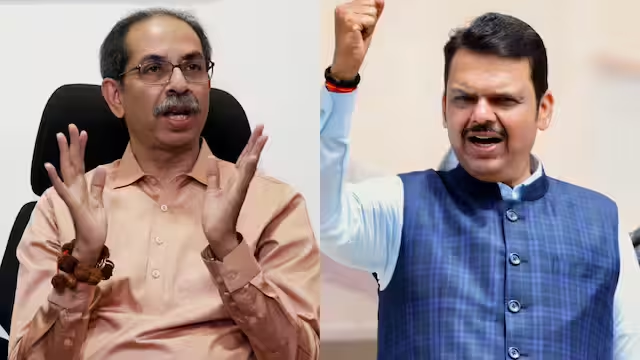
The political landscape in Maharashtra has recently been charged with intense rhetoric, particularly surrounding the figure of Tipu Sultan. A statement made by a prominent leader has ignited a fierce debate, leading to accusations that the BJP is attempting to revive the legacy of Tipu Sultan from the past. This has triggered a strong reaction from the Shiv Sena, which has expressed its outrage over what it perceives as an attempt to distort historical narratives for political gain.
Tipu Sultan, the 18th-century ruler of the Kingdom of Mysore, is a contentious historical figure in Indian history. While he is celebrated by some as a valiant warrior who fought against British colonial forces, others view him as a controversial character due to his religious policies and conflicts. In Maharashtra, where political sentiments are often intertwined with historical figures, the BJP’s reference to Tipu Sultan has been interpreted by the Shiv Sena as a tactic to polarize voters and manipulate historical sentiments for electoral advantage.
The Shiv Sena’s vehement response is indicative of the broader political dynamics in Maharashtra, where regional parties are increasingly wary of the BJP’s strategies. The party has accused the BJP of trying to resurrect historical figures in a manner that selectively highlights certain aspects while conveniently ignoring others. This has led to a heated exchange of words between the two parties, with each side seeking to assert its narrative and claim legitimacy in the eyes of the electorate.
As the political theater unfolds, it is clear that the discourse surrounding Tipu Sultan is not merely about history but is deeply embedded in contemporary power struggles and identity politics. The ongoing debate reflects the challenges faced by political parties in Maharashtra as they navigate the intricate tapestry of history, culture, and regional identity while aiming to connect with voters in an increasingly polarized environment.